

Manufacturing
ALMAX manufactures custom keypads, interfaces, and printed electronics in our own 100% ALMAX-owned plant in Zhuhai, China, with engineering and program management in Carefree, Arizona and U.S. stock and logistics in Kirkland, Washington.
 ISO 9001:2015 · ISO 13485 · IATF 16949 · 100% ALMAX-owned manufacturing
What we build
ALMAX manufactures two product families and nothing off the shelf. Every part is built to your drawing, your artwork, and your host electronics.
Keypads & interfaces. Six assembly types — membrane keypads, rubber keypads, capacitive keypads, smart keypads, in-mold interfaces, and touchscreen interfaces — and three sub-assemblies: metal dome arrays, bare membranes, and touch arrays. Every option a keypad can carry is built in the same plant: backlighting, displays, haptics, gasketing and sealing, EMI/ESD shielding, bezels and housings, optical bonding, and the connector on the tail.
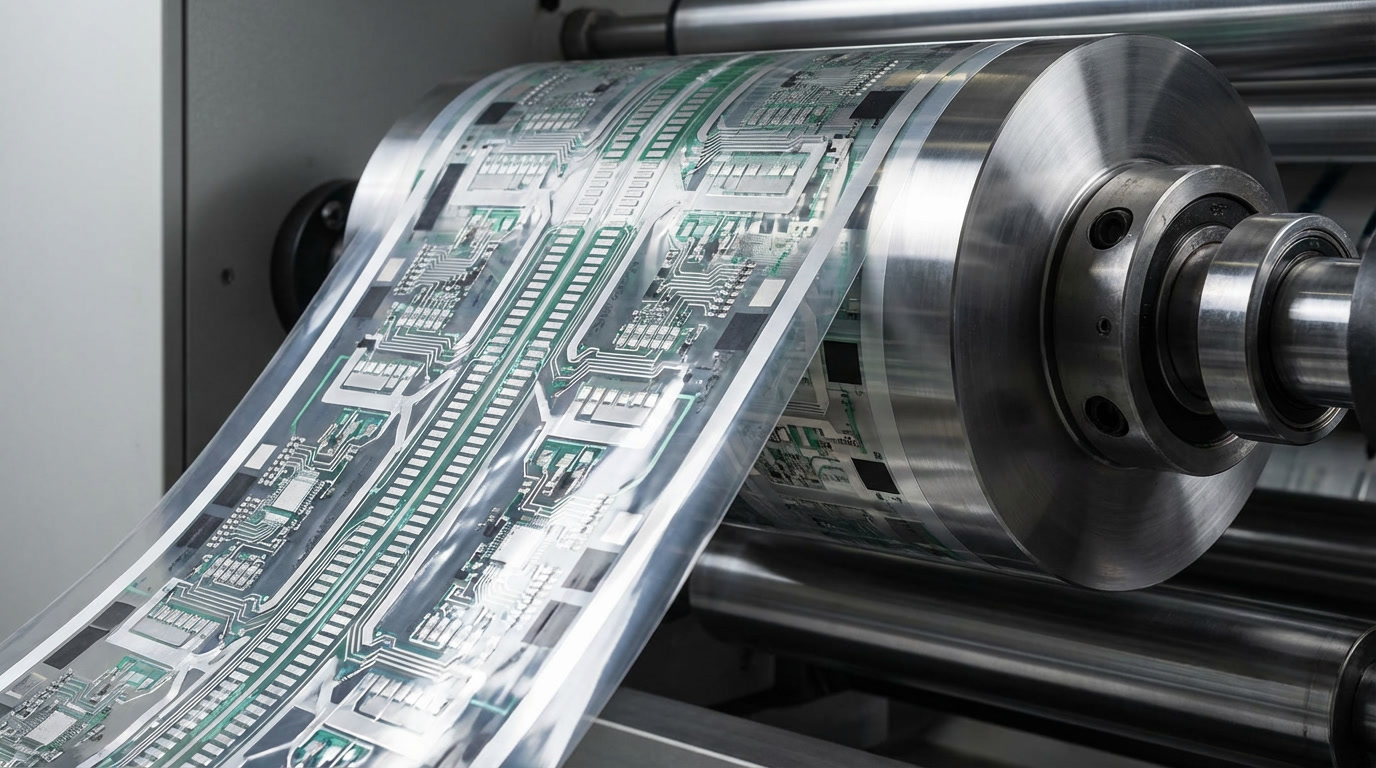
Stretchable, flexible & printed electronics. Printed, flexible, stretchable, transparent (PEDOT), and hybrid (FHE) circuits; in-mold electronics; printed heaters, antennas, batteries, displays, resistors, and solar cells; printed sensors and electrodes; and e-textile constructions.
Eight processes under one roof
A keypad passes through most of these before it ships. Running all eight in one building is what removes the hand-offs — and the tolerance stack-up — that come with a printer in one city, a molder in another, and an assembler in a third.
| Process | What it does | Used for |
| Screen printing | Layer-by-layer deposition of conductive, resistive, dielectric, and graphic inks with camera registration, then thermal or UV cure | Printed circuits, membrane keypads, heaters, antennas & shielding, labels, stretchable & wearable circuits |
| Die cutting & converting | Steel-rule and hard-tool die cutting, kiss cutting, and laser cutting of films, adhesives, and finished stack-ups | Membrane keypads, printed circuits, labels & nameplates |
| Thermoforming & embossing | Key and rim embossing, PolyDome tactile domes, and pre-forming printed films for in-mold processes | Membrane keypads, in-mold (IMD/IME) |
| Compression molding (silicone) | Tooling, durometer selection, flash control, molded-in tactile webs, laser-etched legends, and post-mold coatings | Rubber keypads |
| Injection molding & in-mold decoration | Structural parts, and back-molding decorated or printed films into finished components | In-mold interfaces, smart keypads, bezels and housings |
| Lamination & stack assembly | Adhesive selection, registration, lamination, and final assembly of multilayer constructions | Membrane keypads, capacitive interfaces, touchscreens |
| Optical bonding | Bonding cover lenses, touch sensors, and displays with optically clear adhesive to remove the air gap | Touchscreen interfaces |
| SMT & electronics assembly | Placing and attaching LEDs, controllers, and connectors on flex, printed, and rigid circuits — including conductive-adhesive attach for heat-sensitive printed substrates | Smart keypads, printed circuits, stretchable & wearables |
The floor, by department
| Department | Key equipment | What it means for your part |
| Printing & screen making | Screen-printing stations, including fully automatic lines with CCD camera registration; roll-to-roll screen-printing lines; digital printing stations; UV and IR cure tunnels; roll-to-roll pre-shrink line; robotic dust removal | Multi-layer graphics and circuits held in register; roll-to-roll for volume printed electronics; film pre-shrunk so registration holds through cure |
| Rubber molding | 250-ton two-head vacuum molding presses; laser-etching stations; automatic spray line plus spray cabinets; plasma surface treatment; curing ovens | Silicone keypads with laser-etched backlit legends and soft-touch or PU coatings that stay bonded |
| SMT | Pick-and-place and reflow lines; solder-paste printing; automated optical inspection; ACF bonding; automatic glue dispensing | LEDs, controllers, and connectors placed on flex, printed, or rigid circuits and inspected before lamination |
| Finishing | Die-cutting punch-press stations; hydraulic embossing presses; heat-seal press; pin-crimping stations; roll-to-roll high-speed cutter | Embossed keys, crimped or heat-sealed tail terminations, and outlines cut to the tolerance the method allows |
| Assembly | Dome pick-and-place; hot-pressure and table lamination stations plus a roll-to-sheet laminator; laser-cutting stations; optical inspection of tail dimensions | Domes placed by machine, stacks laminated flat, tails checked before they reach your connector |
| Molding & forming | Plastic injection molding lines; thermoforming; 3D-shape trim die cutting; CNC | Bezels, housings, formed overlays, and in-mold parts from the same plant as the circuit |
| Quality lab | Coordinate measuring machines, semi- and fully automatic; automatic force-curve tester; membrane-switch test stations, including high-voltage; temperature & humidity chamber; adhesive pull-force testers; spectrometers with a D65 booth and Pantone/RAL decks | Dimensions, feel, insulation, adhesion, color, and environmental behavior measured — not eyeballed |
Tolerances we hold
Typical ALMAX capability (August 2026). Tighter is often possible per project — ask before you design to the limit.
| Item | Typical tolerance |
| Overlay thickness | ±0.15 mm |
| Layer-to-layer lamination | ±0.20 mm |
| Graphics print registration | ±0.15 mm |
| Conductive print registration | ±0.05 mm |
| Cut outline — steel-rule die | ±0.20 mm |
| Cut outline — milled die | ±0.10 mm |
| Cut outline — hard tool | ±0.05 mm |
| PCB outline | ±0.10 mm |
| Printed silver line and space | 0.30 mm standard · 0.20 mm in the cleanroom |
| Silicone molding shrink | 0.50 mm per 100 mm, each axis |
Note: these are typical engineering ranges, not quotes. Project specifications come from engineering; pricing and lead time come from sales.
How we pick the cut. Steel-rule die is our default for films up to 0.5 mm (.020 in): it meets tolerance in most applications at the lowest tooling cost. We move to a hard tool when the substrate is thicker, the tolerance is tighter than ±0.13 mm (.005 in), or the volume pays for it. We laser-cut prototypes and runs of roughly 20 or fewer, so a die is never tooled for a part that may still change.
How we prove quality
- Material control. Films, inks, adhesives, and silicones come from a qualified materials list; a material with no qualification does not go on the press.
- In-process inspection. Camera registration on print, automated optical inspection after SMT, tail dimensions checked optically before assembly.
- Final test. Electrical continuity and insulation (including high-voltage), force-curve characterization on tactile parts, dimensional checks on the CMM, color under D65 against Pantone or RAL, adhesion by cross-cut and pull-force, and sampled temperature/humidity exposure.
- Traceability. Lot numbers and manufacturing dates travel with every shipment and every Rapid Inventory® release.
- Certified systems. ALMAX holds three certifications, and every part we build runs under them.
| Certification | Scope |
| ISO 9001:2015 | Quality management system |
| ISO 13485 | Medical device quality management |
| IATF 16949 | Automotive quality management |
From purchase order to your dock
Two ways to buy the same custom part:
- Build-to-order. Purchase order → production in our own factory → direct ship, all at once or staggered to your schedule.
- Rapid Inventory®. Blanket order → production in our own factory → forward-stocked in Kirkland, Washington → released and shipped in days. The reorder never waits on an ocean. Learn more → Rapid Inventory.
Why ALMAX for manufacturing — with the trade-offs
- We own the factory. Direct control of process, quality, and schedule, rather than a managed network of third parties. Trade-off: one primary plant means one production location; U.S. engineering and Rapid Inventory are how we buffer it.
- One roof for print, mold, SMT, form, laminate, and cut. Fewer hand-offs, one tolerance budget, one accountable team. Trade-off: we build what we can build well — when a program needs a process outside our floor, we say so at quote.
- U.S. engineering owns the drawing. The factory drafts, our engineers in Carefree and Kirkland review, you approve. Nothing is built to an unreviewed drawing.
- Numbers, not adjectives. The tolerances above are published so you can design to them.
Industries we build for
Medical devices (ISO 13485) · Automotive (IATF 16949) · Aerospace & defense · Industrial automation, test & measurement · HVAC & building controls · Food-service equipment · Commercial and consumer equipment. The capability leads; the industry follows — the same membrane keypad construction ships into all of them.
FAQ’s
Where are ALMAX parts made?
In ALMAX's own plant in Zhuhai, China — owned outright, not contracted — with engineering and program management in Arizona and Washington. Rapid Inventory stock ships from Kirkland, Washington.
Is there a minimum order quantity?
Can you build a design I already have?
Do you sell standard or catalog parts?
What is the lead time?
Do you support regulated programs?
Yes. ALMAX is certified to ISO 13485 and IATF 16949, with documentation to match the program.