

Design
ALMAX designs the user-facing layer of custom keypads and interfaces: graphic overlays, key layout and feel, backlighting, form, materials, and finishes. Every design leaves our studio as a build-ready package — artwork, stack-up, and dimensioned drawings — sized to the print and lamination budgets of our own factory.
 ISO 9001:2015 · ISO 13485 · IATF 16949 · 100% ALMAX-owned manufacturing
What we design
An interface has five layers of decisions. ALMAX designs all five; you can bring us any one of them half-finished.
| Layer | The decision | What ALMAX delivers |
| Graphics & aesthetics | Overlay material, color, texture, legends, windows, deadfront areas, embossing, brand fit | Print-ready artwork with color specs (Pantone/RAL), texture and coating callouts, window and cutout definitions |
| Inputs — what you touch | Key size, pitch, and layout; tactile construction; touch, slider, wheel, or rotary controls | Key map, human-factors layout, feel specification (force, travel, snap ratio) |
| Outputs — what talks back | Backlighting route, indicators, display windows, haptics, sound | Lighting design with LED placement and diffusion route; display window specs |
| Form | Flat, embossed, thermoformed, molded, or in-mold decorated; curved or sculpted surfaces | 3D CAD and 2D dimensioned drawings of the visible part |
| Structural fit | Thickness, mounting, bezel or frame, sealing at the perimeter | Stack-up drawing with total thickness and mounting method, ready for Engineering |
The choices we make with you — counted, then narrowed
Eight overlay materials. Polyester, polycarbonate, polyester/polycarbonate blend, silicone rubber, acrylic, glass, metal, and in-mold decorated plastic. Polyester is our default for a flat, sealed membrane keypad because it survives the flex of actuation. We move to polycarbonate when a deep emboss or window clarity outranks flex life, to silicone when the design calls for sculpted keys and a soft hand, and to glass or acrylic in front of a capacitive sensor where the surface is the sell.
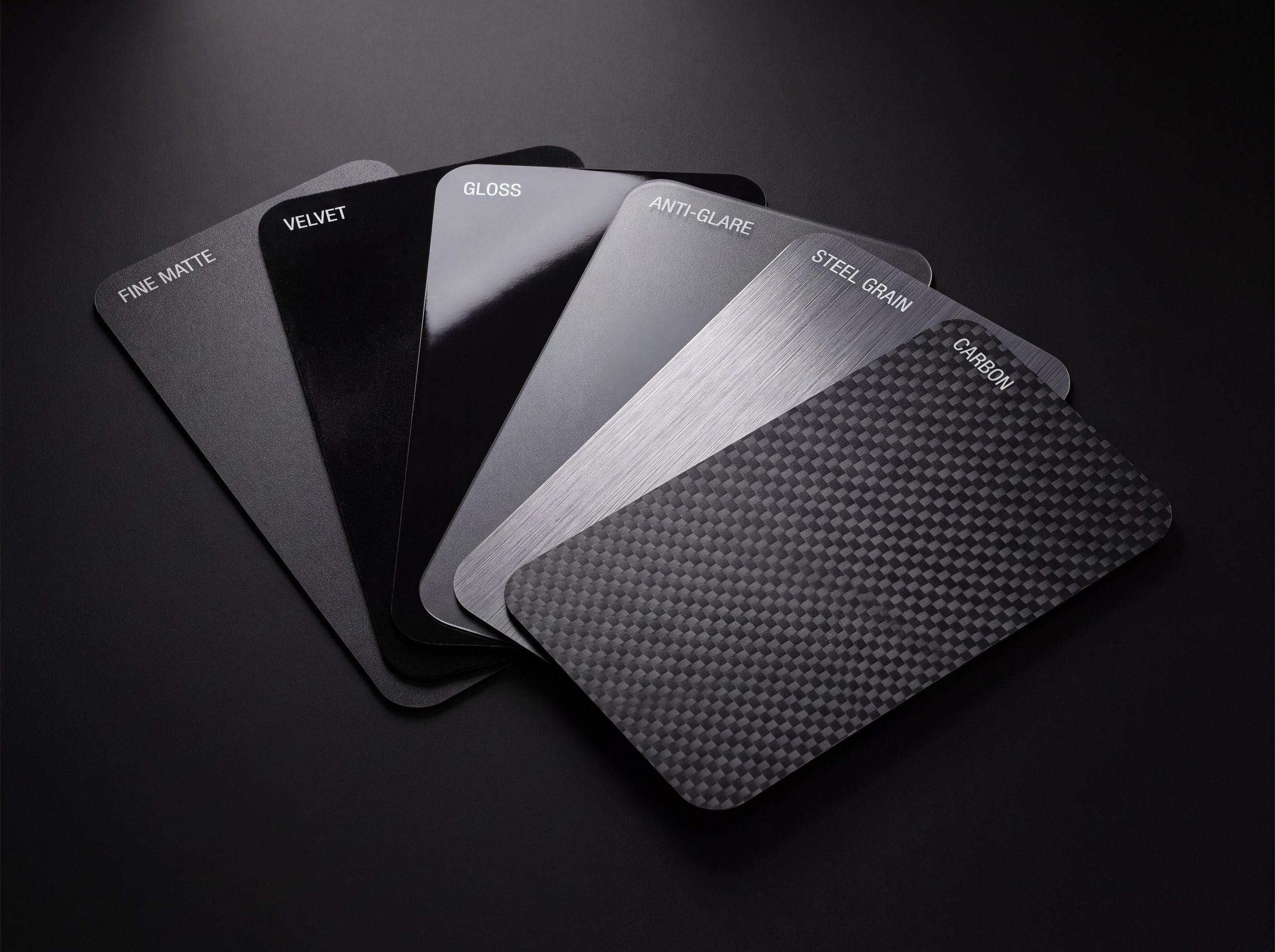
Nine textures and coatings. Fine texture, gloss, velvet, anti-glare, anti-microbial, soft-touch, steel grain, clear, and scratch-resistant. Note: texture changes how a color reads — we approve color on a drawdown of the actual film and texture, not on screen.
Seven backlighting routes. Indicators, top-fire diffusion through a light-guide plate, rubber diffusion, light-guide film, electroluminescent lamps, fiber optics, and colored film. We design from the LED upward: choose the route first, then let the stack follow — a light-guide film chosen after the stack is set will fight the dome for the same millimeter.
Six ways a key can feel. Metal dome, SnapMax®, PolyDome, non-tactile, molded silicone web, and capacitive (no click). Metal dome is our default tactile construction. We move to SnapMax when the feel must outlive the dome’s force–life trade — the same 6 mm dome runs 5 million cycles at 180 g but 10,000 at 300 g (supplier data), whereas SnapMax holds its feel past 5 million actuations typical, 1 million guaranteed (ALMAX datasheet). We drop to non-tactile when thinness and sealing outrank the click, and to PolyDome when tooling budget outranks feel longevity.
Windows and cutouts. On polyester, polycarbonate, acrylic, and glass, a window is simply unprinted film — tinted, backed with a rigid lens, or dotted for a UV-transparent effect. On silicone, the substrate cannot be the window: a rigid acrylic window, typically 2 mm or thicker, is bonded into a cutout.
How a design moves
- Five questions. Where will it live (environment, cleaning, gloves)? What is behind it (host board, connector, mounting)? How thick can it be? What should a press feel like? What must light up? The answers pick the stack — the stack does not pick them.
- Concept. Layout, feel, and lighting options rendered as two or three directions, not twenty.
- Artwork and stack-up. Print-ready files, color specs, texture callouts, and a layer-by-layer stack drawing.
- Design-for-manufacturing review. The design is checked against factory budgets before it is drawn for production: ±0.15 mm graphics registration, ±0.20 mm lamination, ±0.15 mm overlay thickness (ALMAX capability). Artwork that ignores those numbers looks right on screen and wrong in the box.
- Hand-off to Engineering. Circuit, sealing, connector, and firmware decisions continue on the Engineering page; the visible design is frozen with your approval.
- Samples. Typically five to you, shipped within 3 to 5 weeks of drawing approval depending on complexity, for evaluation before production tooling is committed.
Why ALMAX for design — with the trade-offs
- Designers who know the press. Our designers work to the factory’s published print, cut, and lamination tolerances, so artwork survives production without a second revision. Trade-off: we design for the processes we run; when a look calls for a process outside our floor, we say so before you fall in love with it.
- Feel is a specification, not an adjective. Force, travel, and snap ratio are written into the design and verified on a force-curve tester at the factory.
- Color is measured. Pantone and RAL references, checked under a D65 light source with a spectrometer on the production film — not a monitor.
- Proprietary options when they earn their place. SnapMax® for feel longevity, MaxRotor® for rotary input on a flat panel, SensTouch® for touch that is not capacitive. We recommend them when the numbers say so, and say so when they do not.
Applications
Medical device front panels · Handheld and portable instruments · Industrial machine controls · Vehicle and fleet equipment · Laboratory and analytical equipment · Appliance and food-service controls · Wearable and soft-goods interfaces. Anywhere a thin, sealed, branded panel replaces a row of discrete switches.
FAQ’s
Can you work from a logo and a sketch?
Yes. Most programs start with less than a drawing — a sketch, a photo of the enclosure, and a list of functions is enough to open the five questions.
Do I need my own industrial designer?
No. If you have one, we work to their direction and add the factory constraints; if you do not, we design the interface from your requirements.
Can you match our brand colors?
Yes — to a Pantone or RAL reference, approved on a drawdown of the production film and texture. Note: the same ink shifts between a gloss and a velvet texture; approve the drawdown, not the swatch.
Can I design it myself and send files?
Yes. Our membrane keypad design guide lists the rules and the numbers. Send vector artwork (AI or PDF), mechanical files (DXF or STEP), and a drawing; we run the design-for-manufacturing review before quoting.
Will the sample look like production?
Samples come off the same printers, presses, and laminators as production — that is the point of owning the factory. Note: hand-cut or laser-cut sample outlines may sit at ±0.13 mm (.005 in) where the production die holds tighter; we call that out on the sample drawing.